Automation Solutions for New OUH
February 9, 2026
Hospitals & Healthcare
You are always welcome to contact us
We are always ready to help and guide you with expert advice and feedback.


Construction is progressing on Nyt OUH, the Region of Southern Denmark’s super hospital. The same is true of the automation solutions designed to streamline workflows and make them less physically demanding for staff.
At New OUH, the decision was made to consolidate all of the hospital’s support functions into what is known as the Service Center. Serviceby will house the many service departments that work every day to ensure that patients and staff at the hospital itself have everything they need to make treatments, surgeries, inpatient wards, outpatient clinics, and everything else run smoothly.
At Servicebyen, the project management team at New OUH has been exploring how to create the most efficient and user-friendly workflows for the benefit of everyone. Automation solutions are the answer, and Gibotech has been selected as the supplier for several of them. One of the automation solutions is already in use, another has reached the testing phase and will soon be handed over, while the third is currently being programmed.
Automated Sterilization Center
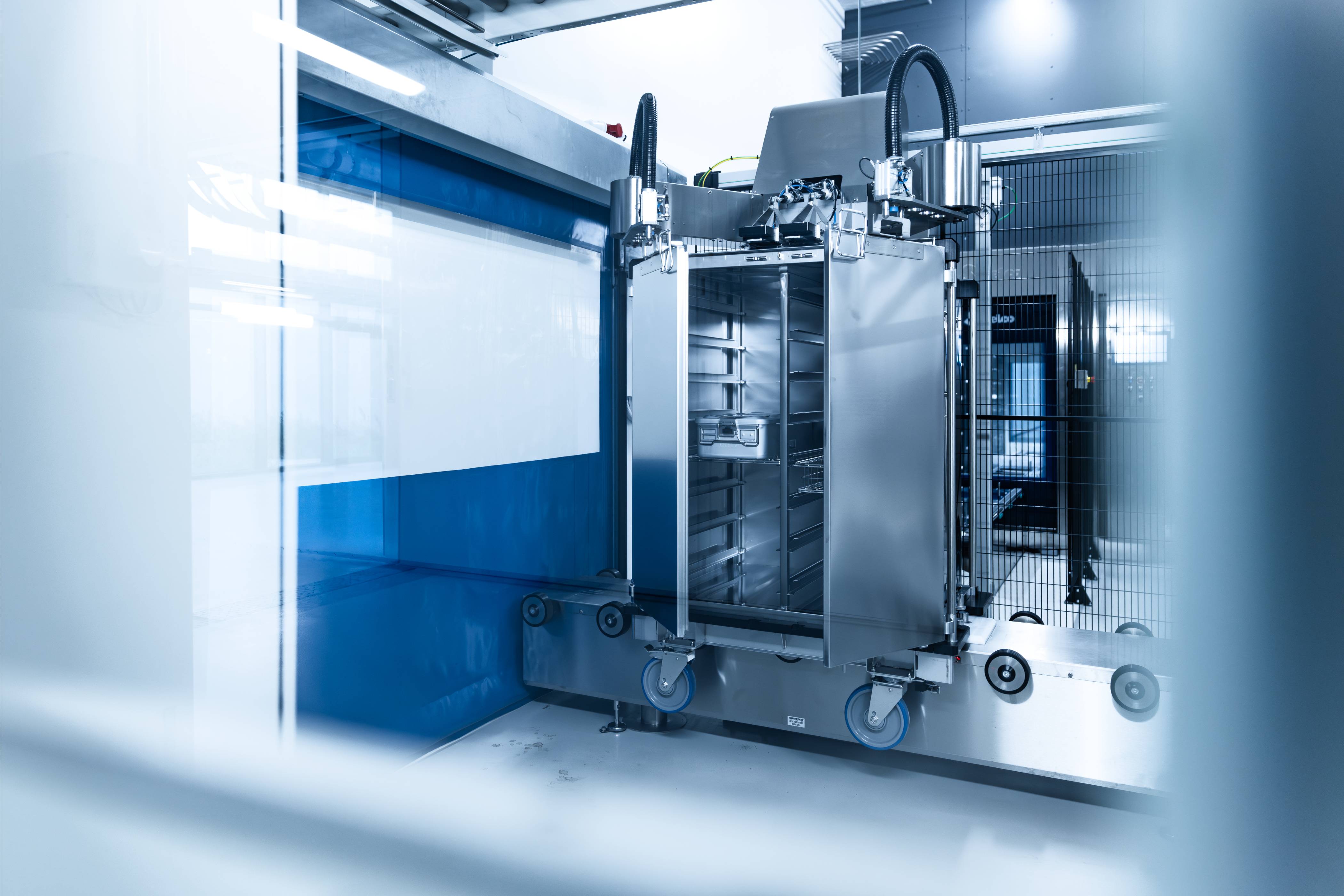
The Central Sterile Supply Department at New OUH will be fully automated. This means that virtually all manual processes that can be standardized will be performed by robots and other technological solutions.
Robots will handle—opening and emptying—trolleys that arrive at the central sterilization department containing used surgical instruments. Conveyor belts and roller tracks transport the trolleys and containers with the instruments, respectively, to the respective areas where the trolleys are washed and the instruments are cleaned and inspected.
The cleaned and sterilized surgical instruments will be stored in the large sterile storage room. The instruments are manually packed into containers so they are ready for surgery. They are then transported via conveyor belts into the sterile storage room, where a storage robot places the container on an available shelf. Because the software keeps track of which instruments are on which shelves, all available shelves can be utilized. When instruments are needed for a surgery, the robot retrieves the respective container, and the conveyor belts transport it out of the sterile storage room.
The Rob-Otto Kitchen Robot
The kitchen at Servicebyen is already up and running. It is currently supplying meals to the existing Odense University Hospital until the new super hospital is ready.
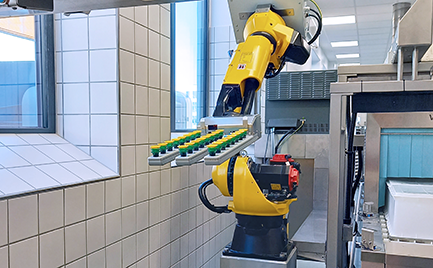
In the kitchen, many of the previously manual processes have been automated. As a result, employees no longer have to push food carts from the dishwashing area to the cold storage room, for example. Nor do they have to empty the food carts themselves—a one-sided, repetitive task that can cause physical strain.
That task has been taken over by Rob-Otto, the kitchen robot. The food cart is wheeled over to the robot, where sensors detect the type of food cart. Rob-Otto then empties the food cart. The robot starts from the bottom and moves upward until it detects a tray. Suction cups hold the tray in place while the robot lifts it over to the dishwasher. Here, the trays are placed on top of the dishwasher, while food storage trays and similar items are turned upside down and placed on the conveyor belt leading into the dishwasher itself.
The logistics system is being tested
A logistics system must not only connect the individual departments within Servicebyen, but also ensure the transport of supplies from Servicebyen to the respective departments at the hospital.
The logistics system in Servicebyen is now installed and ready to be programmed. The system consists of approximately eight kilometers of conveyor tracks and is integrated into more than 30 building sections. It is, for example, waste, linens, goods, and instruments that need to be transported from the hospital to the correct department in Servicebyen—such as the central sterilization unit—or internally within Servicebyen; for example, from the receiving area to the laundry.
Automation benefits both staff and patients
Automating workflows can seem complex, and there’s also a fair amount of groundwork to be done before the system runs as it should.
But the benefits of automation outweigh the effort involved.
Many of the repetitive tasks that take a toll on employees’ bodies are eliminated. Twisting, lifting, and awkward postures—such as keeping one’s hands above shoulder height for extended periods while pushing wire carts around.
Instead, staff can spend their time on patient-centered tasks, quality control, or tasks where a human touch is beneficial. For example, in the central sterilization department, when instruments need to be inspected to ensure they are still in working order.
In addition, workflows become more efficient. Robots and other automation solutions perform exactly the tasks they are programmed to do. They don’t need to take lunch breaks or suddenly walk away to handle another task. This ensures a continuous flow of work, preventing bottlenecks.