CNC machines are a must for vocational schools
January 14, 2026
Industry and CNC
You are always welcome to contact us
We are always ready to help and guide you with expert advice and feedback.

At Syddansk Erhvervsskole in Vejle, they are delighted with their CNC machine. Working with it helps prepare students for the technology they will encounter in the workplace. And with the Danish Parliament’s recently signed agreement to boost vocational education, the time has come to integrate CNC machines—and thus automation—even more deeply into vocational programs.

"Wow, this is awesome!" is often the reaction when students at Syddansk Erhvervsskole in Vejle see the school's largest CNC machine for the first time.
Specifically, the CNC machine is an Ares model from the Italian brand CMS, and it was delivered by Gibotech back in 2018. The investment was made through the National Knowledge Center for Automation and Robotics.
The CNC machine offers opportunities and skills
It is the students in the school’s woodworking programs—primarily the machine woodworking program—who have the opportunity to work with the machine as part of their curriculum. Having a 5-axis CNC machine gives students more options when tackling a given task and simultaneously prepares them for a job market where CNC machines and automation are part of the daily work routine.
As a vocational school, it’s important to us that we can give students the chance to try their hand at the kind of technology they’ll encounter in the workplace. Either during their internship or after they graduate. It’s not certain they’ll end up working with this exact type of CNC machine, but they’ll have had a chance to try out the technology and will have the skills to build on.
Kasper Esager, Head of the Woodworking Department at Syddansk Erhvervsskole, Campus Vejle
Today, it is more the rule than the exception for manufacturing companies to have one or more CNC machines on their premises. Therefore, the workforce of the future must not only be able to machine materials manually or on smaller machines, but they must also understand how larger machines operate and how to program them. And they must know which projects or workpieces would benefit from the use of a CNC machine. Because it’s not just wood that can be processed on a CNC machine, but also materials like plastic and composites. That’s why there are many job opportunities once you’ve truly mastered the technology.
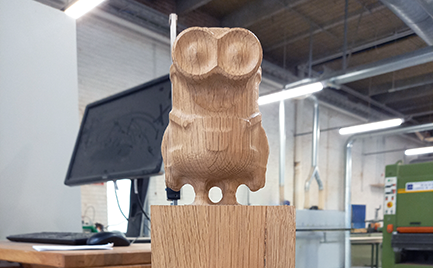
If you have a particular passion for machining on CNC machines, you can specialize in that area. Take, for example, the student who completed their vocational training with a specialization in CNC and, for their final exam, created a spiral made up of several parts—all of which were produced on the school’s CNC machine. Or another student with the same specialization who, for their open-ended project, created a Minion figure.
Handles complex tasks
Of course, not all tasks can or should be done on a CNC machine, which is why the school naturally has several different machines that students use throughout their training. But it is the CNC machines that handle the most complex tasks.
- It does require a slightly different way of thinking compared to other machines, because you have to think in three dimensions and work with up to five axes. That’s why, as a rule, it’s the students in the core program who use the machine, since it requires a basic understanding of materials and tools. They then use the machine to further develop their skills if their internship company already has a CNC machine, or to acquire the skills needed by a future employer, says Henrik Madsen, who is a senior instructor at Syddansk Erhvervsskole, Campus Vejle
- We incorporate the machine into our teaching in various ways. They don’t get specific assignments just for the machine, but they use it when there’s a task that can be solved—either entirely or partially—best on a CNC machine. It does take some time for each student to get comfortable with the machine, so if everyone had to use it at the same time for the same task, they’d end up waiting in line, adds Kasper Esager.
Teachers learn too
It’s not just the students who benefit from the CNC machine. The teachers do too, when they help the students with programming and exploring the machine’s capabilities.
Of course, we took a training course at Gibotech when we got the machine, where we learned how to program it. But it’s really fun when we’re working alongside the students to solve a problem. We learn alongside them as we figure out together how to approach it. This places demands on us as educators to keep up with the times and stay current with new developments.
Henrik Madsen, Senior Instructor at Syddansk Erhvervsskole, Vejle Campus
Ares is suitable for teaching
There are many different types of CNC machines, even when it comes to woodworking, as is the case at Syddansk Erhvervsskole in Vejle.
But the choice of the Ares as a CNC machine could hardly be better, because it has a number of features that make it ideal for teaching.
- Ares is the perfect machine for teaching. The large windows into the work area provide an excellent view, allowing students to follow along during the machining process and see in real time how their programming results in a finished part. And with a clearance height of 1200 mm, it offers excellent opportunities for performing the vast majority of tasks, says Henrik G. Thomsen, Product Manager, CNC at Gibotech.
CNC can take many paths
The agreement reached by the Danish Parliament in August 2023 allocates 300 million Danish kroner annually starting in 2025 and 400 million Danish kroner annually starting in 2030 to boost vocational education and training and make it more attractive to young people. Part of the funds will be used to invest in new and better equipment. And here, vocational schools would do well to explore the many opportunities available in CNC and automation.
- A CNC machine is, of course, just one option when it comes to automation in manufacturing companies. It makes sense to optimize by building on the CNC machine and placing a robot next to it that can help load and unload the material, or by investing in more CNC machines. Either of the same type, so more students can benefit from it, or different types, so you can simulate a production flow just like in real companies, says Henrik G. Thomsen.
So far, Ares has been doing a great job at Syddansk Erhvervsskole in Vejle, to the delight and benefit of both students and teachers.