Gibotech aims to inspire German hospitals to adopt automation
January 14, 2026
Gibotech
Hospitals & Healthcare
You are always welcome to contact us
We are always ready to help and guide you with expert advice and feedback.

The automation of workflows is a growing trend in the healthcare sector. And now, other countries are beginning to look to Denmark for inspiration and to examine existing solutions more closely.
Many routine tasks in a hospital can be effectively automated using robotic systems and mobile robots, freeing up staff time for other, more patient-focused tasks. Many hospitals are already taking this approach and incorporating automation into their plans when constructing new facilities or renovating existing ones.
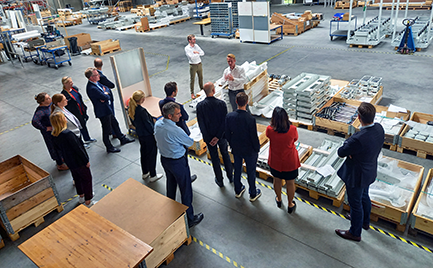
That idea is starting to gain traction in Germany as well. As a result, a Danish-German hospital alliance, the Dänisch-Deutsche Krankenhausallianz (DDKA), has been formed; a delegation of 14 representatives from German hospitals is currently on an inspirational tour of Denmark.
We have formed this alliance to introduce German and Danish players in the fields of digitalization and automation to one another. By visiting suppliers, we hope to foster dialogue and inspire German hospitals to launch more projects. Denmark is of interest to Germany in terms of automation because Danish hospitals are so far ahead.
Olaf Meyer, advisor at the Health in Trade Council Germany, from which DDKA originated
One of the stops on the tour is at Gibotech, a company based in Odense that supplies and installs automation solutions for the healthcare sector in both Denmark and abroad. Among other projects, the company has supplied two central sterilization departments for the University Medical Center Schleswig-Holstein in Lübeck and Kiel, respectively, as well as a goods receiving area and a kitchen for the New Odense University Hospital (Nyt OUH) in Odense.
During the visit to Gibotech, the delegation was shown the automation solutions that the company has previously installed or is currently installing in hospitals. In addition, they were given a tour of the production facilities, where the solutions are assembled and tested before being installed in hospitals. There was particular interest in the automation of hospital kitchens and mobile robots.
- Even though we’ve already made inroads into automation in the hospital sector, we’re always eager to showcase our solutions and share our expertise whenever the industry expresses interest. Especially abroad, we see great opportunities for even greater automation. That’s why there’s such mutual benefit from visits like this, where we can exchange experiences and inspire each other for the work ahead on our respective sides of the project, says Mikkel Bjerregaard, CSO at Gibotech.
There are many benefits
Automation is a broad term that can be difficult to define in concrete terms. There are many possibilities when it comes to streamlining and systematizing routine workflows, allowing staff to spend their time more effectively on other tasks.
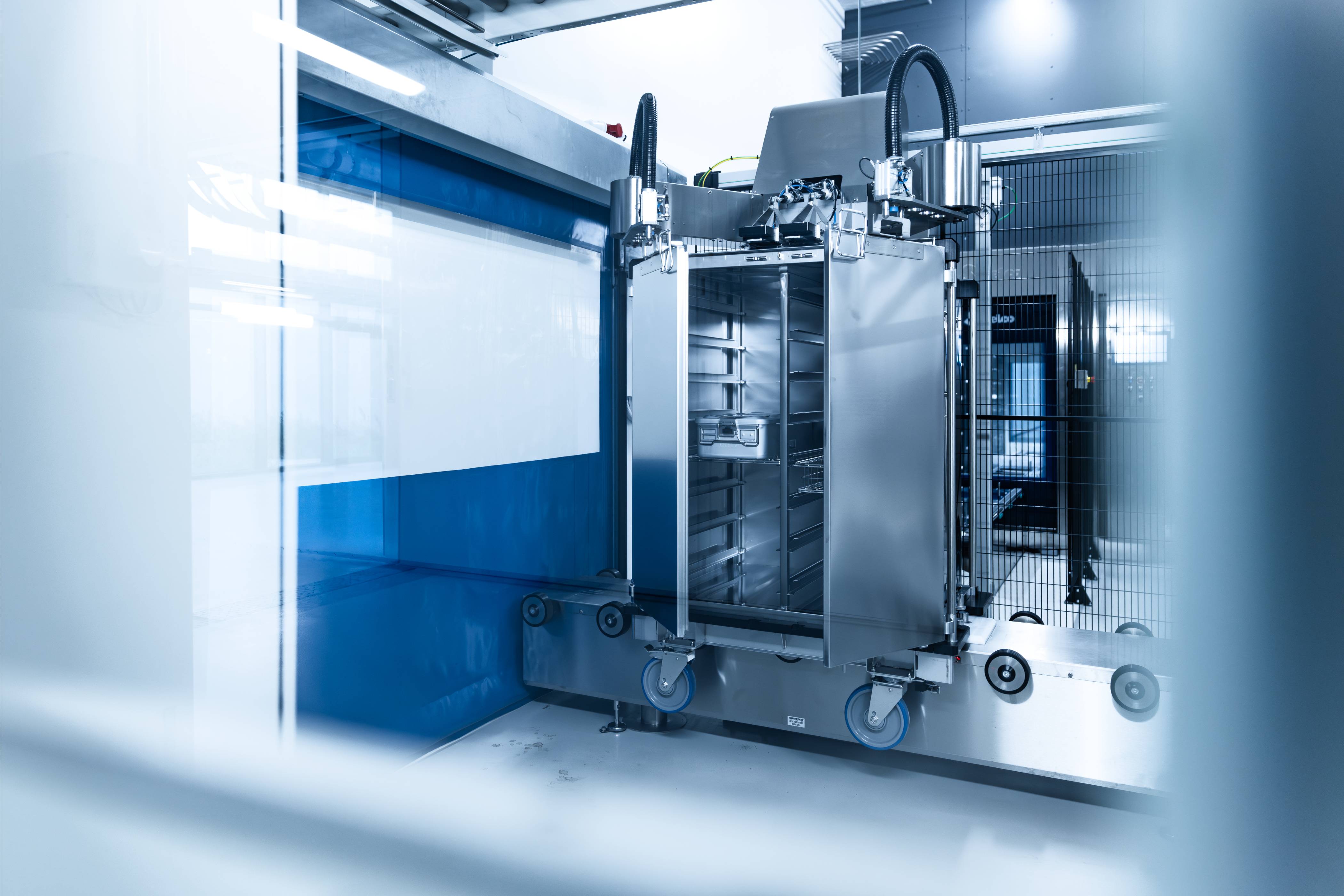
For example, this could be in the receiving area, where conveyor belts move wire baskets back and forth, while mobile robots transport their contents to the relevant departments. Or in a central sterilization department, where mobile robots transport equipment between workstations, and robotic arms place boxes or containers of surgical equipment onto shelves in carts or in the warehouse.
This has the advantage that staff do not have to spend time transporting equipment or materials between departments or workstations, but there are other benefits as well. For example, a better and more ergonomic work environment, where staff avoid lifting heavy boxes and do not have to use their arms, shoulders, and back to push carts. And an automated system is always ready to go and does not require breaks or night shifts.